
The loafer has had a long run. For the better part of a decade, it anchored the smart-casual wardrobe, crossed gender lines, absorbed every micro-trend from horsebit to platform to penny, and became the default answer to the question of what a put-together flat shoe looks like. But something quieter has been pulling focus – and it has a buckle.
Roger Vivier’s Belle Vivier flat, defined by its oversized square buckle set on a grosgrain ribbon strap across the vamp, is not a new shoe. It dates to the house’s founding vocabulary, directly tied to Roger Vivier’s work dressing the late Queen Elizabeth II for her 1953 coronation. What is new is the cultural momentum gathering around it. Across fashion weeks, red carpets, and the kind of street style that gets studied rather than simply photographed, the buckle flat is appearing with a frequency that suggests something beyond a seasonal rotation.
A Silhouette With Staying Power
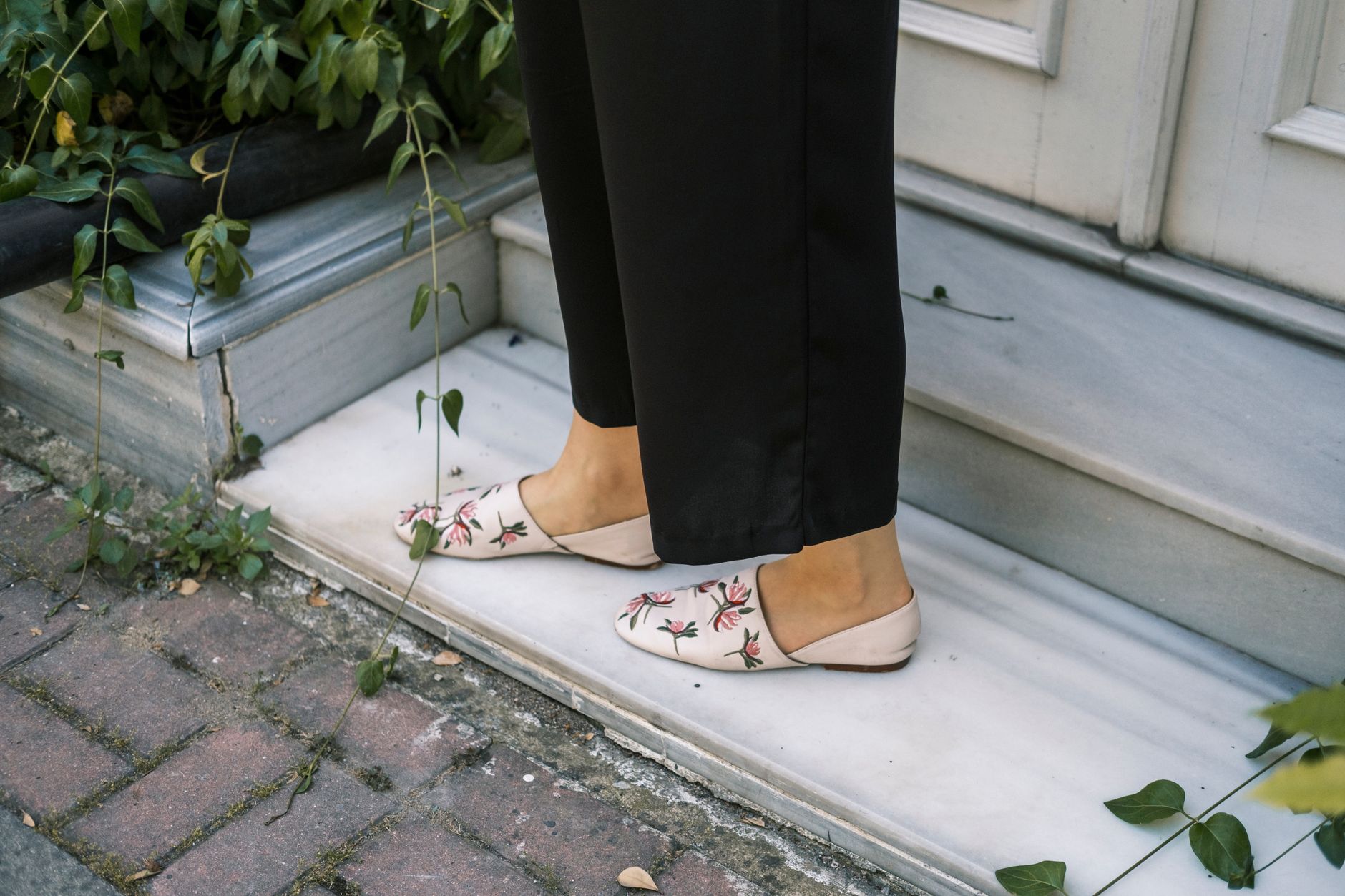
Part of what makes the Roger Vivier buckle flat worth watching is how little it has changed. The proportions are essentially the same as they were decades ago: a modest heel height (or none at all), a squared toe that pre-dates the current squared-toe trend by generations, and that single structural buckle that reads as both restrained and immediately recognizable. The shoe does not need to announce itself through logo print or aggressive branding. The buckle is the signature, and it functions the way a monogram never quite does – as design, not decoration.
There is a logic to why this particular shape is winning right now. After years of footwear vocabulary dominated by chunky outsoles, exaggerated platforms, and the kind of maximalism that demands the shoe be the entire outfit, a flat with genuine architectural clarity offers something different. It is precise without being severe. It works with tailored trousers and it works with bias-cut dresses, which is the kind of versatility that fashion people describe as effortless but is actually the result of very careful design thinking.
How It Stacks Up Against the Loafer
The loafer’s dominance was built on a specific promise: the suggestion of borrowed-from-the-boys ease, the Oxford-adjacent authority of a lace-free leather shoe. For a long time, that promise held. But familiarity has accumulated. The loafer, in every iteration from Gucci horsebit to Bottega Veneta’s lug-sole versions, has become so thoroughly absorbed into mainstream fashion that its ability to signal anything particular has dulled considerably.
The Roger Vivier buckle flat operates on a different register entirely. Where the loafer reads as casual intelligence – the shoe of someone who went to a good school and knows their wine – the buckle flat reads as European formality with enough wit to avoid stuffiness. It belongs to a tradition that includes Balenciaga under Cristobal, Chanel’s two-tone slingbacks, and the specific kind of French dressing that prizes understatement so refined it circles back to extravagance.
Practically, the two shoes solve the same problem – a polished flat for grown-up life – but they solve it differently. The loafer works by blending into an outfit, grounding it without demanding attention. The buckle flat works by being quietly specific: it adds a focal point without disrupting the whole. That distinction is small, but in fashion, small distinctions are the entire point.
It is also worth considering what each shoe communicates about where the wearer’s fashion references live. A loafer in 2025 is a neutral. A Roger Vivier buckle flat is a choice, and a historically literate one. That kind of considered specificity is exactly what a certain fashion audience – the one that has moved past trend-chasing and into something more like connoisseurship – is actively looking for. The embellished flat conversation has been building across several houses, but Roger Vivier’s buckle variant is making the case on purely structural terms, without relying on decoration to carry the argument.
The Celebrity Effect, Without the Usual Noise
The buckle flat’s resurgence has not been driven by a single red-carpet moment or a celebrity endorsement campaign with billboards attached. Instead, it has accumulated visibility the slower way – through repeated appearances on women whose style operates as reference rather than spectacle. Cate Blanchett has worn variations. The French fashion world, which tends to treat Roger Vivier as simply correct rather than aspirational, has never stopped wearing them. That kind of sustained, low-temperature visibility is actually more durable than a viral moment, because it does not peak and crash.
The house itself has been deliberate about not over-expanding the silhouette into every possible colorway and collaboration. The core Belle Vivier remains recognizable across seasons, available in satin, patent, and leather versions that update through color and embellishment without altering the fundamental shape. That restraint is commercially counterintuitive but culturally smart – it keeps the shoe from feeling exhausted.

Where the Trend Is Heading
Flat shoe enthusiasm is not new, and not every flat is gaining the same ground. What separates the Roger Vivier buckle flat from the broader flat shoe conversation is the specificity of its design DNA. It is not a ballet flat, with all the casualness that implies. It is not a mule, with the effortlessness that has its own saturation problem. It occupies a more particular position: the dress shoe that does not feel punishing, the formal flat that does not look defeated.
Some brands are experimenting with buckle-strap flats at lower price points, and the silhouette is beginning to appear across the contemporary market in ways that suggest wider adoption is already in motion. The question that follows from that is whether broad availability will dilute the original’s appeal or simply confirm its authority as the source.
Roger Vivier has navigated that question before. The buckle has been copied across five decades, and the original has survived every round of imitation, largely because the craftsmanship gap between the house’s version and its derivatives is visible to anyone paying attention – and the people who choose Roger Vivier are, almost by definition, paying attention. The shoe retails at a price point that makes it a considered purchase rather than an impulse, which means its buyers are arriving with research done and expectations set, not discovering it on a markdown rack.