

The printed bikini has had a long run – tropical florals, abstract geometries, tie-dye gradients cycling in and out of resort collections for decades. But something quieter is pulling attention away from bold pattern play this season: broderie anglaise, the embroidered cotton fabric most associated with Victorian blouses and summer dresses, is showing up at the water’s edge in a way that feels genuinely new.
From the Countryside to the Coast
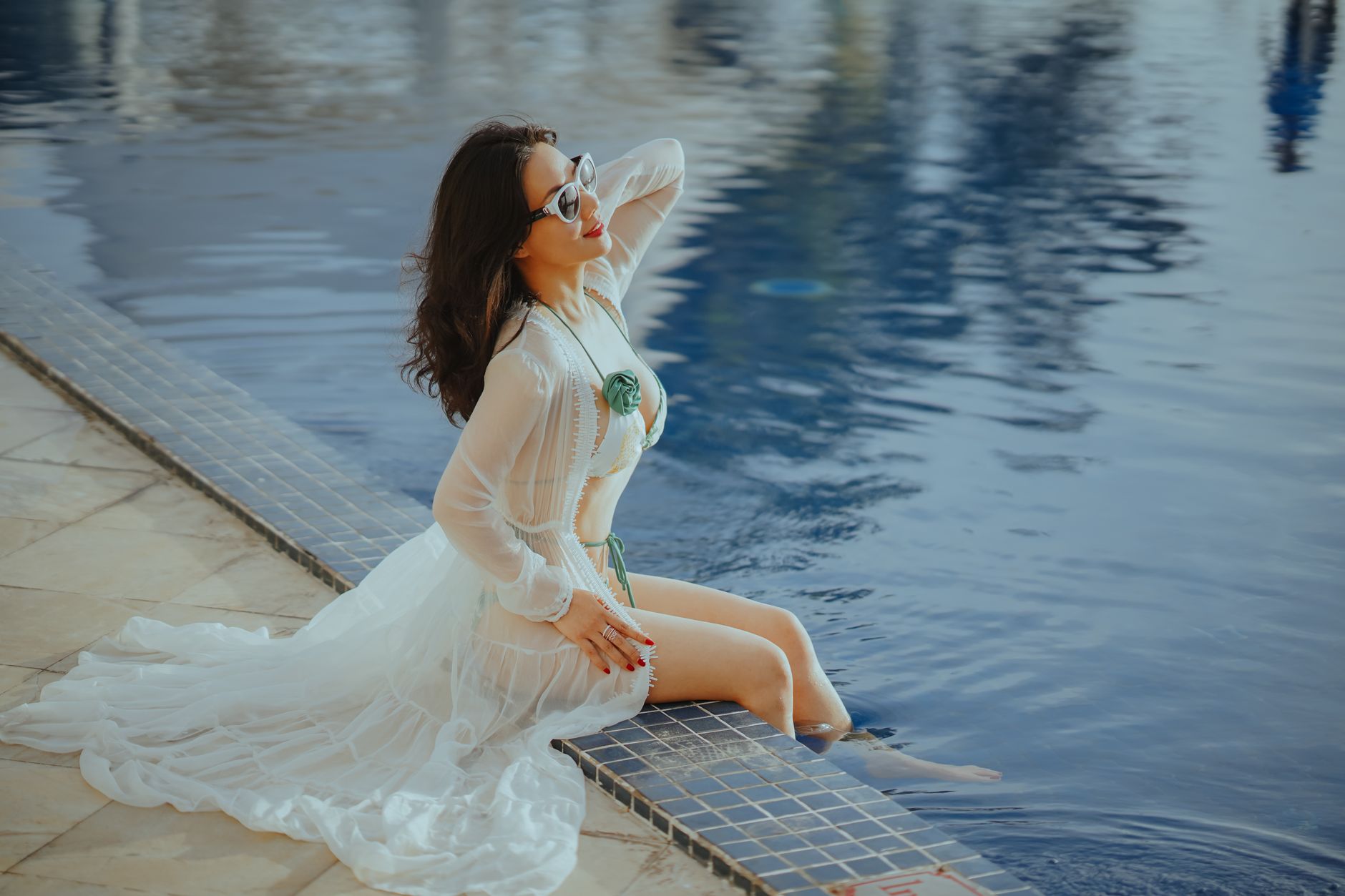
Broderie anglaise – French for “English embroidery” – is defined by its distinctive pattern of small, precisely cut holes edged with tight stitching, typically worked in white or off-white cotton. For most of fashion history, it belonged firmly to the realm of blouses, peasant tops, and children’s clothing. Its migration into swimwear is not an obvious move, and that is exactly what makes it interesting. When a fabric associated with modesty and delicacy lands on the beach, the contrast does most of the work.
The aesthetic logic is straightforward. Broderie anglaise reads as inherently elevated – the craftsmanship is visible, the texture is tactile, and the white-on-white tonal quality photographs cleanly without competing against a backdrop. On a beach or poolside, where printed bikinis have to fight for distinction against umbrellas, towels, and the general noise of a holiday environment, the restrained embroidery of a broderie anglaise piece stands out by doing less.
Designers have been threading this fabric into resort and swim collections gradually over the past few seasons, but the approach has shifted. Earlier interpretations tended to treat broderie anglaise as trim – a border detail on a coverup, an edging on a sarong. The current direction is more committed: full bikini tops cut entirely from the fabric, structured one-pieces using it as the primary material, and matching sets where the embroidery is the design rather than a decorative addition.
The fabric also works because it exists at an interesting intersection of textures. It is opaque enough to function as swimwear, lightweight enough to dry quickly, and structured enough to hold a clean silhouette without underwiring. That is not a small achievement for a natural-fiber fabric moving into a category typically dominated by synthetic stretch materials.
Why the Printed Bikini Is Losing Ground
The printed bikini is not disappearing – it is too commercially embedded for that. But there is a visible fatigue with certain categories of print that has been building for a couple of seasons. The maximalist tropical print, the abstract color-block, the retro polka dot – these have been cycled through so many mass-market collections that they have lost their ability to signal anything specific. When a pattern shows up identically across fast fashion and luxury resort lines, the print stops functioning as a style marker.
Broderie anglaise benefits directly from this saturation. It reads as considered in a way that a floral print no longer can, partly because the production is inherently more labor-intensive. The embroidery requires additional process steps beyond fabric dyeing, which keeps broderie anglaise pieces slightly higher on the cost spectrum and, by extension, less likely to flood the market at volume. Scarcity – even relative scarcity – maintains the sense that a piece is a choice rather than a default.
There is also a color argument. The dominance of white and off-white in broderie anglaise swimwear connects to a broader appetite for tonal dressing that has been running through every category from tailoring to casualwear. White swimwear is perennially tricky – it demands a certain confidence and creates obvious practical concerns – but that slight edge of difficulty is part of its appeal. Wearing it suggests intentionality rather than convenience.
The one-piece silhouette has also amplified the fabric’s appeal. As structured one-pieces continue to hold ground against the bikini in editorial and street-style coverage, they have created more surface area for fabric-forward design. A bikini top offers limited canvas; a sculpted one-piece in broderie anglaise can carry the fabric’s embroidered texture across a full design, making the material the entire statement. Some recent resort collections have leaned into this with high-neck or corseted constructions that borrow from lingerie without crossing into it.
Styling around the swimsuit has followed the fabric’s lead. Broderie anglaise pieces are being worn with linen trousers, espadrilles, and minimal gold jewelry rather than the cover-up-and-flip-flop formula that printed bikinis typically orbit. This shifts the swimsuit from vacation-specific item to something that functions within a broader warm-weather wardrobe, which is exactly the kind of versatility that tends to sustain a trend past a single season.
What Comes Next for the Fabric

The risk for broderie anglaise swimwear is the same risk that ended the printed bikini’s moment of feeling special: volume. If the fabric moves from boutique resort collections into mass production at scale, the detail that makes it distinctive – the visible craft, the slight rarity – erodes quickly. A broderie anglaise bikini from a fast-fashion retailer is a different object than the same silhouette from a small swim label working with quality cotton. The embroidery may look similar in a product thumbnail, but the finish and longevity are not comparable, and that gap becomes apparent fast.
For now, the versions driving the trend are coming from labels that treat fabric sourcing as part of the design process. The question is how long that distinction holds once broader retail catches on – and whether the fabric’s inherent production demands will slow the inevitable duplication enough to give it a longer runway than most swim trends manage.