



Statement earrings had a long run. For the better part of a decade, they were the go-to tool for elevating a simple outfit – the chandelier drop, the sculptural hoop, the oversized abstract shape dangling at the jaw. But something quieter has been gathering momentum on the collar line, and it is not a necklace.
The Return of the White Collar – and Why It Hits Different Now
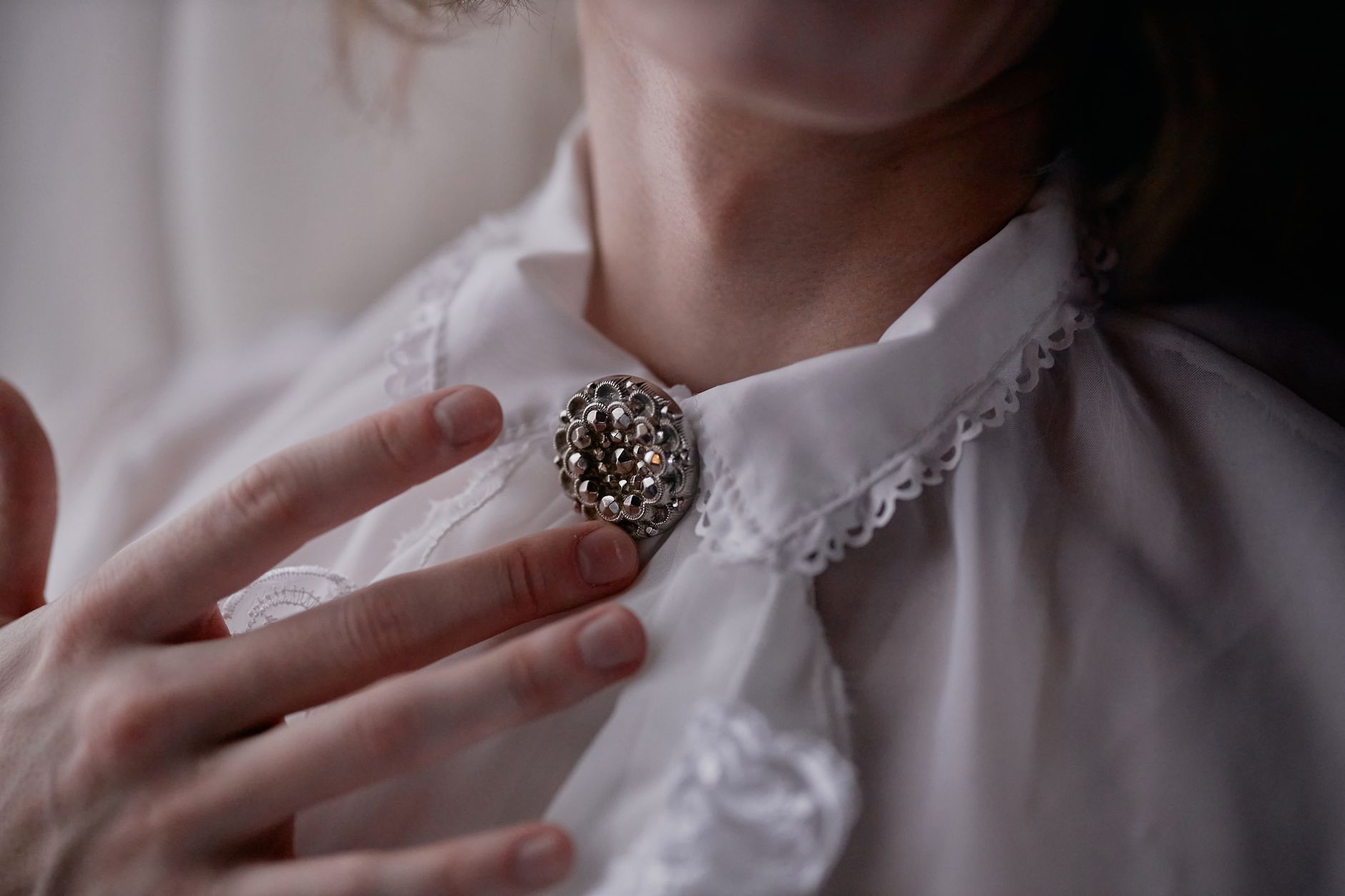
Broderie anglaise – the cutwork embroidery technique characterized by small oval or round holes edged with stitching, typically worked in white cotton – has existed in Western fashion since at least the 16th century. It has surfaced repeatedly across different eras: on Victorian undergarments, on 1970s prairie blouses, on children’s christening gowns. What it has rarely been, until recently, is genuinely cool.
The current iteration is not about nostalgia, even if the fabric itself carries centuries of memory. Designers have been isolating the collar specifically – detaching it from the broader garment, or positioning it as the dominant design detail on otherwise minimal pieces. A crisp white broderie anglaise collar sitting against a dark sweater or a tailored blazer functions almost architecturally. It frames the face the way a good earring does, but it does it from below the chin rather than beside the cheek, which shifts the focal point of an entire look.
That shift in focal point is the real story here. Statement earrings work by drawing the eye upward and outward, pulling attention to movement and color. A broderie anglaise collar does the opposite – it anchors the eye at the neckline, creates a clean break between face and body, and reads as deliberate without being loud. For anyone who has grown tired of the noise that comes with heavily accessorized dressing, the collar offers a way to look considered without adding visual weight.
This is also, in part, a reaction to how accessories have been used over the last several years. The statement earring became so ubiquitous that it stopped making statements. A giant resin hoop or an architectural drop went from being an expression of individuality to being a shorthand that almost anyone could pick up at any price point. The broderie anglaise collar, by contrast, requires being sewn into or onto something – it is structural, not afterthought.

How Designers Are Actually Using It
The collar is appearing in a few distinct ways, and not all of them are precious or ladylike, which is part of what makes the trend interesting. The most direct version is the detachable collar worn over a knit – a separate piece that clips or ties at the back of the neck and sits over whatever is beneath it. This approach is openly utilitarian in its logic: you are adding the detail without committing to a full garment, which gives the collar the same practical flexibility that statement earrings always promised.
A second approach involves garments where the broderie anglaise collar is built into a piece that is otherwise completely plain – a black dress with a white embroidered collar, or a dark shirt where the collar is the only moment of decoration. This version reads as more polished, closer to the prep-inflected dressing that has been moving through fashion for the past couple of seasons. It nods to school uniforms and vintage workwear without being a costume.
There is also a third version that is more editorial: broderie anglaise as collar-adjacent – yokes, bib fronts, and wide decorative necklines that extend further down the chest than a traditional collar would. These pieces borrow the aesthetic language of the collar while functioning more like a top or blouse in their own right. They are harder to wear but more dramatic, and they have been showing up on runway looks alongside otherwise stripped-back styling, specifically because they carry enough visual interest on their own that nothing else is needed.
What unites all three approaches is restraint elsewhere. Styling choices around these collared looks tend toward the minimal: simple trousers, unfussy footwear, and notably – no earrings, or very small ones. This is not accidental. The collar and the statement earring occupy the same visual real estate. Wearing both at full volume creates competition. The current lean is toward choosing one, and increasingly, the collar is winning that decision.
The accessories picture is worth examining closely here. A growing number of fashion editors and stylists are pairing embroidered collars with small studs or nothing at all, letting the collar carry the detail load entirely. This tracks with a wider appetite for understated carry and quieter dressing overall – a preference for pieces that do their work through craft and construction rather than size or statement.
What This Means for How You Dress
Practically speaking, the broderie anglaise collar is one of the more accessible trend entries available right now. Detachable versions are widely available at various price points, vintage and secondhand markets are full of blouses and dresses where the collar is the best feature, and the technique itself is durable enough that older pieces hold up well. The learning curve is mostly about proportion – collars read best when they sit flat and wide rather than narrow and upright, and the contrast between the white eyelet work and whatever is underneath it needs to be clear enough to register.
What remains genuinely unresolved is whether the broderie anglaise collar will stay as clean and minimal as it currently looks, or whether it will absorb the maximalist tendencies that eventually overtook the statement earring. Bigger, more elaborate collar constructions are already appearing – wide lace-edged versions, multi-layered ruffs, collars with trailing ribbons. If the trend follows its usual trajectory, the quiet version is probably the one worth investing in now, before the category floods.