



Where Minimalism Meets Desire
Ludovic de Saint Sernin built his reputation on a very specific kind of restraint – the kind that removes everything except what the body does on its own. Since launching his namesake label in 2017, the French-Belgian designer has worked in the narrow space between couture discipline and outright provocation, producing pieces so spare they function almost as arguments: a barely-there mesh top, a low-slung bias-cut skirt, a tank dress cut to the exact millimeter that separates fashion from something else entirely. The work is deliberate, technically rigorous, and quietly confrontational in a way that louder designers rarely achieve.
Now something is shifting in how luxury fashion absorbs that language. The codes de Saint Sernin has refined – skin exposure as structure, the body as the primary material, sensuality as an organizing principle rather than an accent – are appearing in collections far removed from his downtown Paris atelier. This isn’t imitation so much as convergence: the broader luxury market catching up to a visual vocabulary that once read as niche.
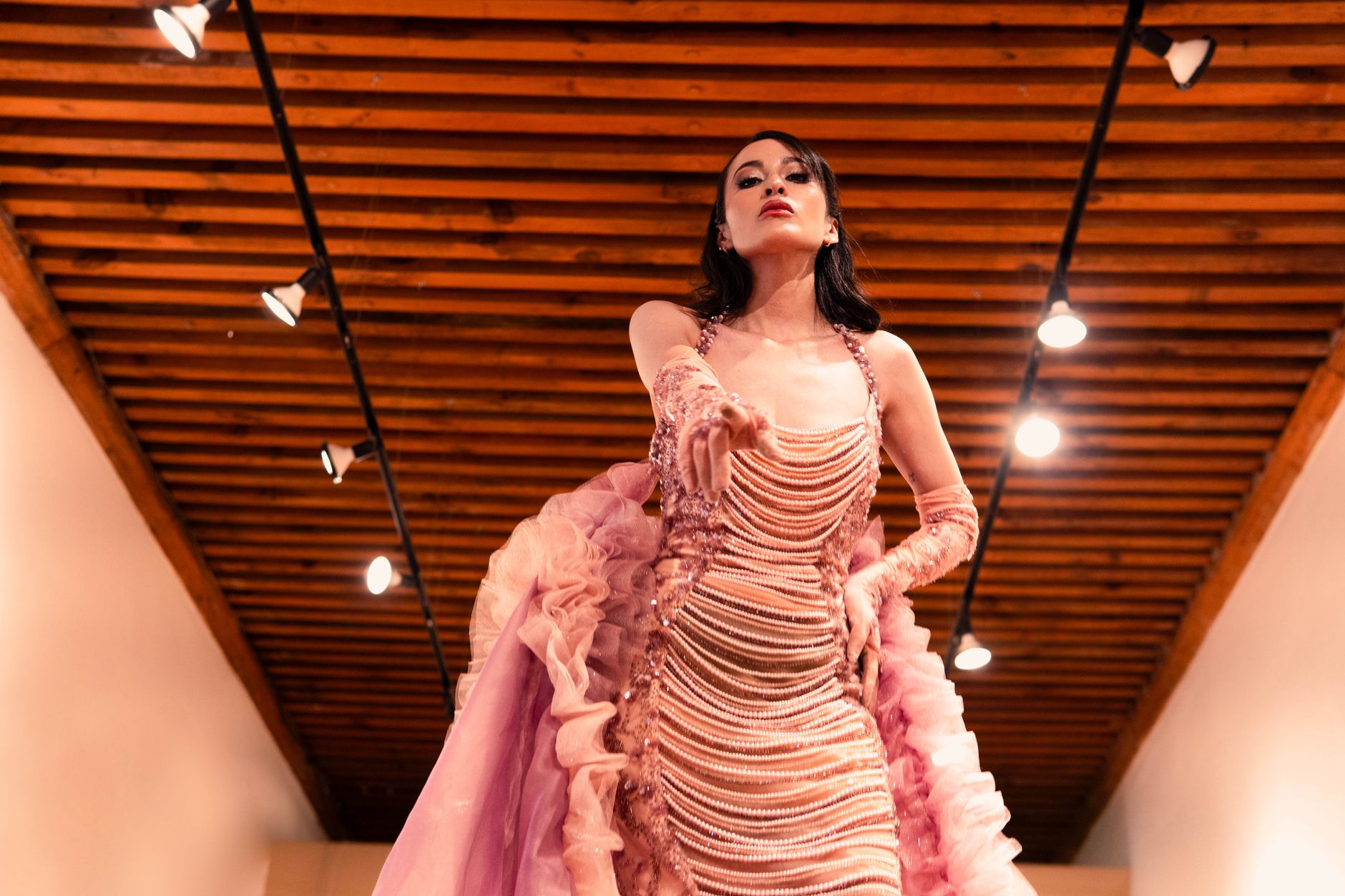
The Anatomy of His Aesthetic
What makes de Saint Sernin’s approach distinct from standard “sexy fashion” is a matter of intention and control. Where many designers deploy exposure as decoration, he treats it architecturally. A cutout is placed not to reveal but to direct attention – to frame a collarbone, to interrupt a line, to create negative space that gives the garment its structure. The body isn’t being shown off; it’s being edited. That distinction is why the work reads as high fashion rather than lingerie dressed up as ready-to-wear.
His materials reinforce this logic. Liquid jerseys, second-skin lace, micro-weights of satin that move with rather than against the body – these are textiles chosen because they respond to movement and warmth, because they remember the shape underneath them. There’s an intimacy built into the fabric selection that most luxury houses never attempt, partly because it requires a very specific kind of confidence in the cut and partly because it demands that the wearer commit to the garment’s terms.
He also works in a tradition that has real couture roots. The bias cutting, the minimal construction, the prioritization of drape over scaffolding – these connect to Madeleine Vionnet’s early 20th-century experiments and to the body-conscious work that characterized Paris in the late 1970s and 1980s. De Saint Sernin doesn’t reference these lineages explicitly, but they’re structurally present in how his clothes behave. That historical grounding is part of why luxury buyers and critics take the work seriously; sensuality with craft credentials sits differently than sensuality without them.
How Luxury Is Absorbing the Signal
The absorption is happening along two tracks simultaneously. The first is direct: established houses experimenting with more exposed silhouettes, thinner materials, and deeper cuts than their recent history would suggest. A number of Spring 2025 collections showed evidence of this – evening pieces stripped back to near-nothing, daywear with cutouts placed at the waist and sternum rather than the standard shoulder or hem. The aesthetics aren’t de Saint Sernin’s exactly, but the permission structure behind them – the idea that a luxury garment can prioritize the body’s presence over its own construction – that part is recognizable.
The second track is subtler: a recalibration of what “quiet luxury” actually means. The past few years pushed high-end fashion toward a kind of deliberate visual silence – neutral tones, covered-up silhouettes, the studied absence of anything that might read as wanting attention. That mode has been tested by houses reaching back toward structure and authority, but de Saint Sernin’s influence suggests a different kind of correction: not more volume or tailoring, but more body. Sensuality as the thing that was always missing from the restrained aesthetic.
Why This Moment Is Receptive
The cultural appetite for this shift has been building for a few years through adjacent channels. Film, music, and fashion photography have been steadily rehabilitating the idea that dressing with visible desire is a form of self-possession rather than its opposite. The conversation around bodily autonomy has made sensual dressing feel like a choice with stakes rather than a passive default, which changes how it reads when it appears on a runway. Clothes that once might have been dismissed as purely provocative now carry a more complicated charge.
Luxury’s hesitation around this territory has always been partly about brand risk and partly about a class-coded suspicion of anything that reads as too direct. The traditional high-fashion language of wealth involves concealment, layering, the demonstration of privilege through what you don’t need to show. De Saint Sernin’s work inverts that logic entirely. His clothes are expensive precisely because they have nowhere to hide – the construction must be flawless because the body makes it visible, the fabric must behave because there’s no structure to compensate. This is luxury through radical exposure rather than through accumulation, and it requires a different kind of confidence from the wearer.
What the broader market is currently working out is whether that confidence can be sold alongside the more familiar forms of luxury signaling, or whether it requires abandoning them. Some brands are experimenting with hybrid approaches – adding a de Saint Sernin-adjacent cutout to an otherwise covered-up silhouette, or using his fabric sensibility on a traditionally structured piece. These attempts produce interesting clothes but occasionally miss the point, because the logic of his aesthetic depends on commitment. A single exposed panel on a heavily constructed coat is decoration; the same exposure applied consistently across a whole silhouette becomes a statement about what the clothes are for.
The designer himself has remained largely outside the acquisition and partnership conversations that reshape other independent labels at this stage. Running a small atelier gives him a precision over the work that scale tends to erode, and the precision is the product. Whether luxury conglomerates decide they want to absorb that or simply borrow its surface codes will determine whether this particular influence deepens or dissipates into seasonal trend noise – the same question that faces any genuinely specific point of view once the industry decides it wants a piece of it.

Frequently Asked Questions
Who is Ludovic de Saint Sernin?
Ludovic de Saint Sernin is a French-Belgian fashion designer who launched his namesake label in 2017, known for minimalist, body-conscious designs that treat sensuality as a structural principle.
Why is Ludovic de Saint Sernin influential in luxury fashion?
His work combines couture-level construction with radical exposure, demonstrating that sensuality and technical precision can coexist – a combination that larger luxury houses are increasingly drawing from.